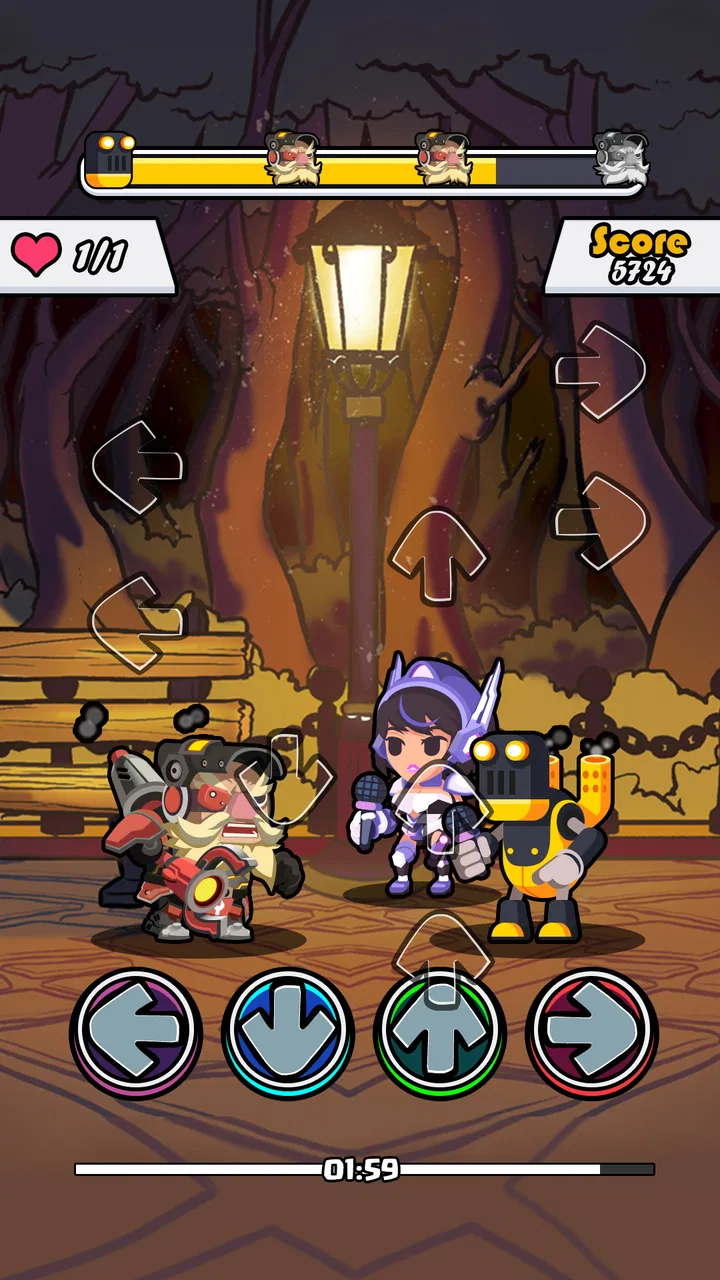
Beat Battle Full Mod Fight
- 4.1
- Rating
- 10.00M
- Installs
- Free
- Price

 Analysis by App-foxy
I spent time with Beat Battle Full Mod Fight as a music game, and my first impression was that it is built around quick reactions rather than relaxed listening. The appeal is easy to understand: songs become battles, the screen asks for timely input, and the satisfaction comes from staying in rhythm while the pressure rises. It is free to download, aimed at a Teen audience, and developed by BeatBitTech. That makes it an approachable choice for players who want a rhythm game they can try immediately without committing to an upfront purchase.
What matters most here is not whether you already know music games, but whether you enjoy repeating a difficult section until your hands and ears finally agree. I found the experience more rewarding when I treated each attempt as practice instead of expecting an instant win. The game’s store summary promises full weeks and all mods, while its short description presents it as a beat battle. In practical terms, that points toward a broad, content-focused experience rather than a tiny rhythm demo.
How Beat Battle feels during ordinary play
In ordinary play, I find the key decision is less about how long I have and more about whether I can give the screen and music my attention. A brief, focused attempt can fit neatly into a spare moment, while interruptions make even familiar patterns harder to follow. I’d use that distinction to choose when to play, then look at how the game’s feedback shapes each run.
You May Also Like

 Blood Strike: 2.5 Anniversary
Blood Strike’s Loadouts Turn Every Drop Into a Tactical Gamble
A close look at Blood Strike’s custom loadouts: how fast access to signature weapons reshapes its battle royale rhythm, rewards preparation, and narrows the gap between fights.

 Pandora - Music & Podcasts
Pandora’s Music Is Easy to Start, but Harder to Recover
Pandora’s strength is its low-effort path from a seed to a station. Its weak spot is how much confidence it asks you to place in connection, setup, and quiet recovery.

 8 Ball Pool
 Is Built on Rivalries, Rematches, and Routine
A close look at the rivalries, rematches, shared routines, and unanswered safety questions that turn a quick pool match into a persistent mobile community.

 Samsung Music
’s Quiet Strength Is Playing What You Already Own
Its reach comes less from spectacle than from dependable access to a personal library. That simplicity is both the app’s strongest retention engine and its ceiling.

 AccuWeather: Weather Radar
AccuWeather Review: A Quick, Clear Forecast for Everyday Decisions
For everyday plans, the best forecast is the one you can understand quickly. AccuWeather makes rain timing, radar, and local conditions easy to act on, with a few trade-offs.

 Hill Climb Racing
Why Hill Climb Racing Still Turns Crashes Into One More Run
A tiny car, a bumpy hill and one more upgrade: Hill Climb Racing keeps resurfacing because its simple chaos makes every near-miss feel personal.
More From Our News Desk



Fast starts and the importance of timing
The game gets to its main idea quickly. You are not opening it for a long strategy session or a story-heavy adventure; you are opening it to follow music and respond at the right moment. That directness is one of its strongest qualities. When I had only a short break, I could focus on a single battle instead of setting aside a large block of time to understand complicated systems.
The perceived speed depends heavily on how comfortable you are with rhythm games. A beginner may experience the same track as a blur of prompts, while an experienced player sees a pattern that can be read and anticipated. I recommend starting with a calmer difficulty or an easier section whenever possible, because learning the visual rhythm first is less frustrating than immediately chasing perfect performance.
There is also a useful distinction between musical speed and interface speed. A song can feel fast because the notes arrive close together, but a clear pattern may still be manageable. Conversely, a less frantic sequence can be difficult if its timing feels unfamiliar. I paid more attention to the spacing and flow of inputs than to the song’s energy alone, and that helped me decide whether a failure came from poor timing or from simply needing more practice.
What happens when the action gets busy
The heavier moments are where this game earns its place as a beat battle. Once several inputs arrive in quick succession, casual tapping stops working. I had to watch the screen, listen for the beat, and keep my hands relaxed. Tensing up made me react late, especially after a mistake. A better routine was to continue following the next cue instead of mentally replaying the error I had just made.
That makes the game suitable for short bursts of focused play, but less suitable if you want something to run in the background while you multitask. Music games punish divided attention more than many other mobile genres. If you are commuting, waiting for an appointment, or taking a quick break, it can be enjoyable. If you are trying to watch another video or hold a conversation at the same time, the core challenge loses its purpose.
One practical tip is to use the opening part of a track as a calibration period. Rather than pressing aggressively from the first cue, I watched how the game presented the rhythm and adjusted my timing. This small habit reduced unnecessary restarts. Another is to stop after a few increasingly poor attempts. Fatigue can feel like a technical problem because reactions become slower, but taking a short pause often produces a better result than forcing another immediate run.
Managing repeated attempts without wasting them
Rhythm games naturally invite repetition, and this one is no exception. The useful way to repeat a battle is to identify one specific weakness: missing a certain direction, losing the beat during a busy passage, or reacting too early after a pause. I found that naming the problem made practice more productive than simply replaying the whole track with the vague goal of doing better.
This is also where the “full weeks” and “all mods” positioning matters to the overall value. Players who enjoy variety should have more reason to keep exploring than players who only want one short challenge. I would still judge the game by how much you enjoy its central rhythm loop. More content can extend a good rhythm game, but it cannot make repeated timing practice enjoyable for someone who dislikes that style of play.
Stability, loading expectations, and recovery
My view of reliability is tied to the kind of session this game creates. A rhythm battle needs a consistent response because even a small interruption can break concentration. I therefore prefer playing when the phone is not busy with several other demanding tasks. Closing unnecessary background activity before a longer session is a sensible precaution, not because the game is unusually demanding, but because rhythm play leaves little room for distraction.
Recovery is important too. If I made a poor attempt, the best recovery was usually immediate and simple: breathe, reset my grip, and focus on the next run. If the application needs to reload after an interruption, that pause can feel more annoying here than in a turn-based game because the musical focus has already been broken. For that reason, I would avoid starting a serious attempt when I expect a call, a notification-heavy period, or another app to take over the screen.
I did not treat every missed input as evidence of instability. In a game built around timing, a miss can come from pressing early, pressing late, watching the wrong area, or losing the beat. Separating those causes is useful. If the music continues normally and the interface responds consistently, the issue is probably technique. If the whole session feels interrupted or uneven, restarting the game and reducing background activity is a more reasonable first step than blaming your timing.
Older phones and practical device limits
The game supports devices running Android 7.0 or later, which gives it a broad compatibility range. That does not mean every supported phone will feel identical. Screen size, touch responsiveness, available memory, and the age of the device can all affect comfort during dense passages. On a smaller display, the challenge may be reading the cues quickly; on an older touchscreen, the challenge may be maintaining confidence in every tap.
I would be especially careful about storage and battery expectations during extended sessions. Music games can encourage “one more attempt” play, and a short session can quietly become much longer. If your phone already struggles with heat or battery drain during games, this is worth considering before choosing it as your main rhythm title. I cannot recommend it as a low-resource certainty for every device, but its minimum Android requirement makes it accessible to people who are not using the newest hardware.
A useful device-side adjustment is to play with the phone held securely rather than balancing it loosely in one hand. Stability helps more than people expect when the input pattern becomes busy. I also prefer a quiet environment for difficult tracks, because hearing the beat clearly can compensate for some visual overload. These are simple changes, but they make the same hardware feel more dependable.
Free access and the question of spending
The game is free, which lowers the barrier to trying it. It also includes in-app purchases ranging from $0.99 to $49.99 per item. That range is important for anyone who dislikes unexpected spending pressure. I recommend deciding in advance whether you are comfortable staying with the free experience or setting a firm purchase limit. A rhythm game should be enjoyable because of the play, not because a player feels pushed to pay after a difficult section.
For me, the best approach is to explore the available content first and only consider spending if the game has already earned a regular place in my routine. Players who want a completely purchase-free experience should be cautious, while players who understand mobile optional purchases may find the free entry point convenient. The presence of purchases does not automatically make the game poor value, but it does make personal boundaries part of the decision.
Who will enjoy it most
This is a good fit for people who like music games with a competitive edge. If you enjoy chasing cleaner runs, learning patterns, and improving through repetition, the beat-battle format has a clear appeal. It also suits fans who want a substantial selection of weeks and mods rather than a single tiny challenge. The average rating of 4.2 from around 106 thousand ratings suggests that many players find the concept worthwhile, although a rating cannot predict whether its timing style will suit your hands.
I would recommend it to a friend who wants a game for focused breaks and does not mind failing while learning. It is less convincing for someone looking for a calm music player, an open-ended creative tool, or a game that can be played successfully with minimal attention. Players who dislike repeating the same section should also think twice. The central pleasure comes from improvement, and improvement often requires doing a difficult passage more than once.
Where it differs from familiar alternatives
Compared with casual tap-to-the-beat games, this one feels more like a performance contest. The emphasis is not simply on touching the screen when music is present; it is on surviving a structured battle and improving your response. Compared with traditional console-style rhythm games, the mobile format is more convenient but also more dependent on the phone’s touch surface and the conditions around you.
That trade-off makes the choice fairly clear. If you want portability and quick access, Beat Battle has an advantage over games tied to dedicated controllers. If you want the most precise physical feedback, a controller-based rhythm game may feel better. If you want a purely relaxing soundtrack experience, a music app is obviously a better match. This title sits between those options as an active, attention-demanding game that turns listening into a test of coordination.
Small habits that improve the experience
I found three habits particularly useful. First, play the same section with a relaxed grip; tension makes late reactions more common. Second, use a short warm-up before attempting a difficult battle, because jumping straight into the hardest pattern can make the game seem faster than it really is. Third, when progress stops, change the goal from winning to identifying the exact moment where control is lost. That turns frustration into information.
Another less obvious trade-off is sound versus screen dependence. Listening carefully can help you anticipate rhythm, but relying only on audio is risky if the visual cues do not match your expectations. I used both channels together: the screen told me what to do, while the music helped me prepare. Players who mute or lower the sound may still be able to play, but they are removing one of the game’s most useful timing references.
Long-term value and final performance verdict
Beat Battle Full Mod Fight has reached over ten million installs, and its current version is 5.8. Those figures place it among games with a large enough audience to be more than an obscure experiment. More importantly, its value lasts only as long as you enjoy the loop of listening, reacting, failing, and improving. The broad content promise helps, but the real test is whether you want to return after a difficult run instead of closing the game.
My performance verdict is positive with sensible limits. The game feels most effective in short, focused sessions on a device that responds reliably to touch. It can become demanding during dense musical passages, and that demand is intentional rather than a flaw. I would not choose it for passive play, for a completely interruption-proof experience, or for someone who wants to avoid all in-app purchase considerations.
For the right player, though, it is an easy recommendation. The free entry point lets you judge the rhythm and responsiveness for yourself, the music-game format gives short breaks a clear purpose, and the full-weeks-and-mods approach offers a reason to keep practicing. My main advice is to treat it as a focused skill game, not background entertainment. If that sounds appealing, BeatBitTech’s game is worth trying; if you want relaxation or guaranteed simplicity, a less demanding music alternative will serve you better.
FAQs for Beat Battle Full Mod Fight
01What is Beat Battle Full Mod Fight about?
Beat Battle Full Mod Fight is a rhythm-based game that challenges players to hit notes in time with the music. It features a variety of songs and levels, each with increasing difficulty. Players can compete in battles, unlocking new mods and characters as they progress through the game.
02Is Beat Battle Full Mod Fight free to play?
Beat Battle Full Mod Fight is free to download and play with optional in-app purchases. Players can enjoy a wide range of features without spending money, but additional content and cosmetic items are available for purchase to enhance the gameplay experience.
03What are the system requirements for Beat Battle Full Mod Fight?
To run Beat Battle Full Mod Fight smoothly, Android users need a device with at least Android 5.0, while iOS users require iOS 10.0 or later. The game is optimized for both smartphones and tablets, ensuring a smooth experience across different devices.
04Does Beat Battle Full Mod Fight support multiplayer mode?
Yes, Beat Battle Full Mod Fight includes a multiplayer mode where players can challenge friends or random opponents online. This feature allows players to test their skills against others, adding a competitive edge to the rhythm-based gameplay.
05Are there regular updates and new content for Beat Battle Full Mod Fight?
The developers of Beat Battle Full Mod Fight frequently release updates that include new songs, characters, and mods. This ensures that the game remains fresh and engaging, providing players with new challenges and content to explore regularly.
Pros
- Engaging rhythm-based gameplay.
- Wide variety of music tracks.
- Challenging levels for all players.
- Intuitive controls enhance experience.
- Frequent updates with new content.
Cons
- In-app purchases can be pricey.
- Ads can interrupt gameplay.
- Limited offline functionality.
- Some tracks require unlocking.
- Occasional lag on older devices.

Beat Battle Full Mod Fight
Gallery